
Shoulder condition or diagnosis
Rotator Cuff Tendinopathy and Tears
Rotator Cuff Tendinopathy and Tears
In plain language: The rotator cuff is a group of four tendons that helps lift, rotate, and center the shoulder. Tendons can become painful, partially torn, or fully torn—and the scan does not always predict how much a person hurts.
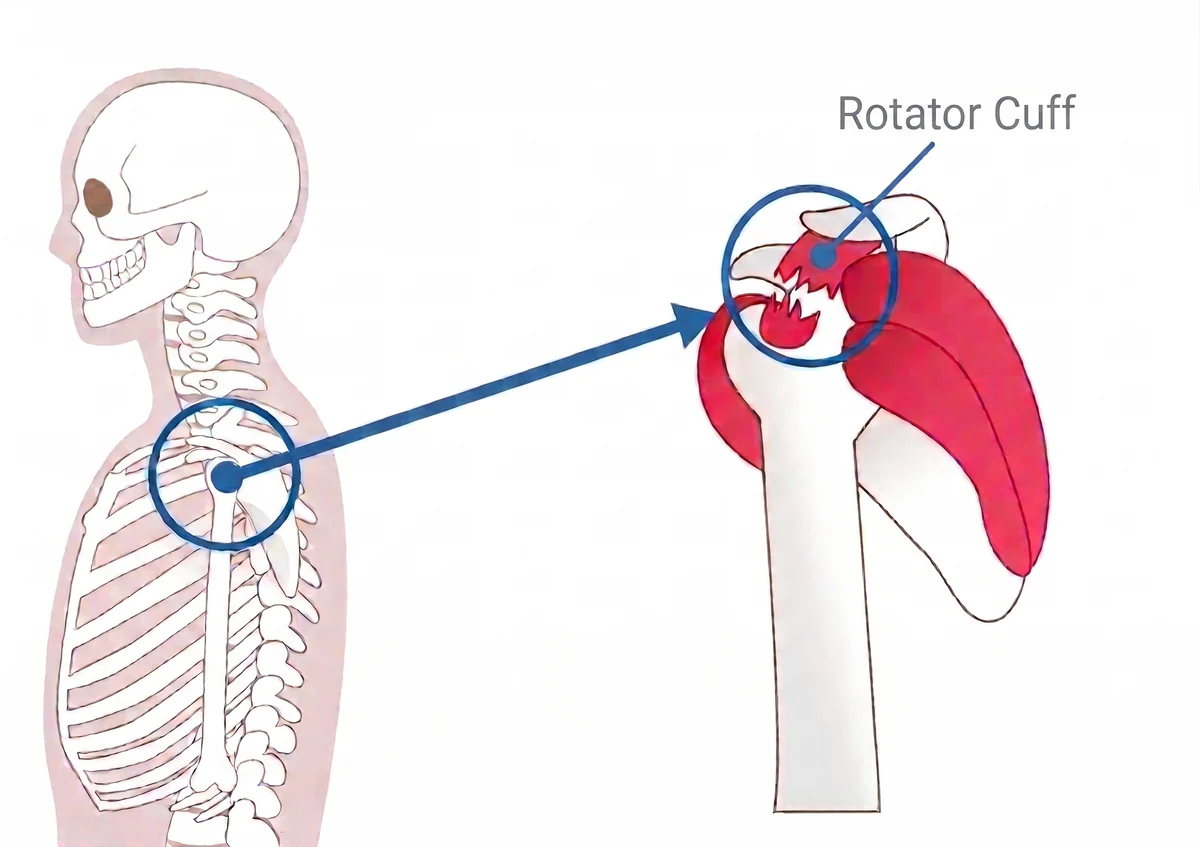
What happens to the rotator cuff
The supraspinatus, infraspinatus, subscapularis, and teres minor tendons form the rotator cuff. Tendinopathy describes a tendon that has become painful and changed over time. A tear may involve part or all of a tendon’s thickness and can occur gradually or after trauma.
Age-related tendon changes are common. Some people have a tear on imaging without major symptoms. The meaningful question is whether the tendon finding matches your pain, weakness, function, and examination.
Symptoms
Common symptoms include pain with overhead reaching, lifting away from the body, dressing, or lying on the affected side. Pain may spread down the upper arm. Weakness can be pain-limited or reflect loss of tendon function. A traumatic tear may cause sudden pain and immediate difficulty raising the arm.
How it is diagnosed
The examination checks shoulder motion and the strength of specific rotator cuff movements. X-rays do not show the tendon directly but can identify arthritis, bone shape, and other causes. Ultrasound or MRI may be appropriate when a tear is suspected. In acute pain with negative or unclear X-rays, both can be reasonable next tests.
Treatment options
Many patients begin with physical therapy, activity changes, and symptom medication when appropriate. Therapy improves motion, shoulder-blade mechanics, and the capacity of the cuff and surrounding muscles. In complete tears, physical therapy may improve symptoms even though the tear itself can enlarge over time.
A subacromial corticosteroid injection can provide short-term pain and function improvement for selected patients, but repeated injections require careful consideration. PRP may be discussed selectively. The 2025 AAOS guideline does not support routine PRP use for rotator cuff tendinopathy or partial tears because the research is inconsistent. BMAC for a nonsurgical cuff injection remains emerging.
Orthopedic referral may be appropriate after an acute traumatic tear with meaningful weakness, for a large or progressing tear, or when a well-matched nonsurgical plan has not restored acceptable function.
When to seek prompt care
Seek prompt assessment for sudden weakness after injury, inability to lift the arm, deformity, major swelling, new numbness, or a cold or discolored arm. Fever with a hot swollen joint needs urgent care.
Sources
- AAOS 2025 Clinical Practice Guideline: Rotator Cuff Injuries
- AAOS Plain Language Summary: Rotator Cuff Injuries
- American College of Radiology: Acute Shoulder Pain
This page provides general education and does not establish whether an imaging finding is the source of your pain.
Clinically reviewed by Keley John Booth, MD
Get urgent care for these
- The shoulder looks deformed or a bone may be broken after an injury
- The arm is cold, pale, blue or severely swollen
- New major weakness or loss of feeling
- Fever with a hot, red, swollen shoulder
- Shoulder pain with chest pressure, shortness of breath, sweating, or pain spreading to the jaw or arm
These need assessment now, not an appointment next week. Go to an emergency department or call 911.