
Shoulder condition or diagnosis
AC Joint Arthritis and Injury
AC Joint Arthritis and Injury
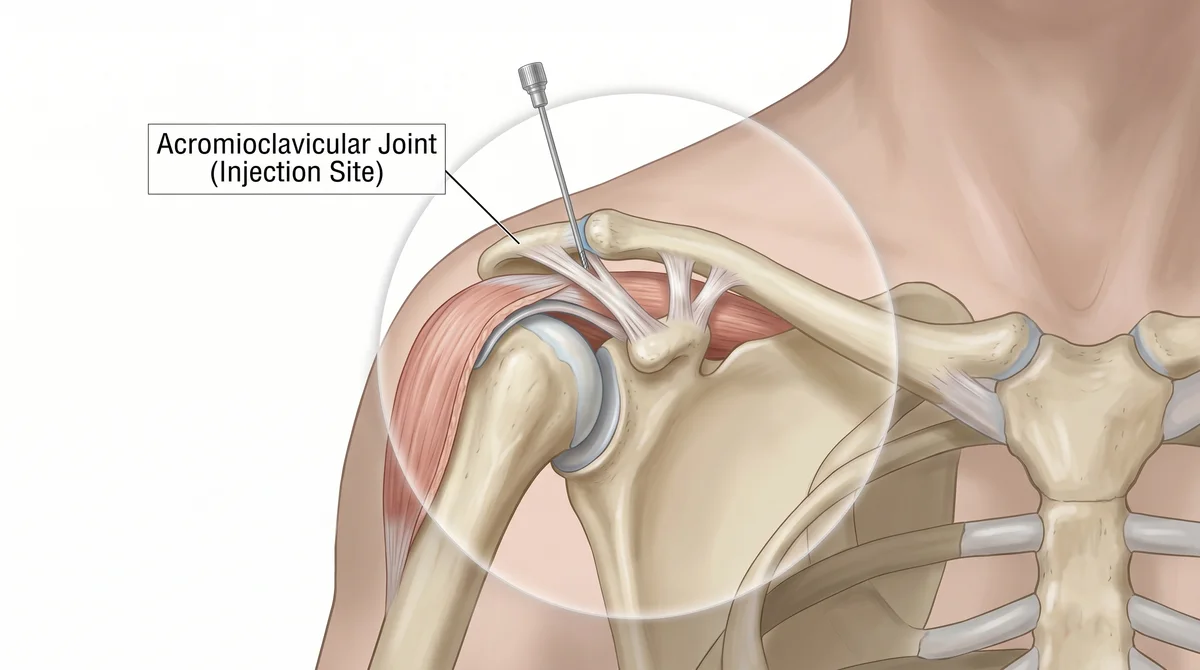
In plain language: The acromioclavicular, or AC, joint is where the collarbone meets the top of the shoulder blade. It can become arthritic over time or injured by a fall onto the shoulder.
Symptoms
AC joint pain is usually focused at the top of the shoulder. Reaching across the body, pushing up from a chair, bench pressing, or sleeping on that side may reproduce it. After trauma, swelling or a visible bump may occur when the supporting ligaments are stretched or torn.
AC joint changes are common on imaging and are not always painful. The clinician checks whether direct pressure and cross-body movement reproduce your familiar symptoms.
Diagnosis
X-rays can show arthritis, alignment, or a separation after injury. Ultrasound or MRI may be useful for selected soft-tissue questions. When more than one shoulder structure could be responsible, an image-guided diagnostic AC joint injection can help estimate how much pain comes from this small joint.
Treatment options
Many AC joint injuries and arthritic flares improve without surgery. Early care may include temporary protection, activity changes, appropriate medication, and therapy to restore motion and shoulder control. Return to heavy pressing or contact activity should be progressive.
An image-guided AC joint corticosteroid injection may provide temporary relief. PRP or bone marrow aspirate concentrate injection into the AC joint is offered for selected patients, but shoulder-specific evidence is limited. These treatments should be described as conditional or emerging, not as proven cartilage regeneration.
Orthopedic evaluation may be appropriate for a high-grade traumatic separation, persistent instability or deformity, or pain that remains limiting after a well-matched nonsurgical plan.
When to seek prompt care
Seek prompt evaluation after a major fall, with obvious deformity, inability to use the arm, new numbness, or an arm that is cold or discolored. Fever with a hot swollen joint requires urgent care.
Sources
- American College of Radiology: Acute Shoulder Pain
- American College of Radiology: Chronic Shoulder Pain
- AAOS OrthoInfo: Shoulder topics
This page is educational and does not grade an individual AC joint injury.
Clinically reviewed by Keley John Booth, MD
Get urgent care for these
- The shoulder looks deformed or a bone may be broken after an injury
- The arm is cold, pale, blue or severely swollen
- New major weakness or loss of feeling
- Fever with a hot, red, swollen shoulder
- Shoulder pain with chest pressure, shortness of breath, sweating, or pain spreading to the jaw or arm
These need assessment now, not an appointment next week. Go to an emergency department or call 911.